

The FORZA State of Grassroots Football Report 2026
Grassroots football in the UK is at a crossroads, with clubs across the country voicing their concerns about the challenges they face amid the current climate and economic pressures. With the 2026 World Cup dominating the national conversation throughout the summer, the clubs that form the backbone of the beautiful game have too often felt forgotten.
We surveyed 409 clubs across the UK this summer for our FORZA 2026 State of Grassroots Football report. Respondents included chairman, secretaries, players, coaches, committee members and treasurers. 43% of those respondents have been involved with grassroots football for 15+ years, so no one is better placed to comment on the state of grassroots football in 2026. The responses from clubs across England, Scotland, Wales and Northern Ireland have painted a picture of communities that are passionate and resilient, but under significant pressure.
Some of the key findings remain stark. Building on our 2025 report, funding, facilities and volunteering efforts are still under threat. New findings reveal that refereeing is becoming increasingly problematic, and while women's and girls' football continues to grow, there are barriers that are holding back even greater progress.
Here are the key statistics:
- 57% of clubs do not feel they have sufficient funding to support their activities.
- 54% of clubs state they don’t have enough equipment to operate.
- More than two thirds (68%) of clubs have a women's or girls' team or are currently in the process of setting one up.
- 9 in 10 (90%) clubs have witnessed abuse directed at a match official in the past 12 months
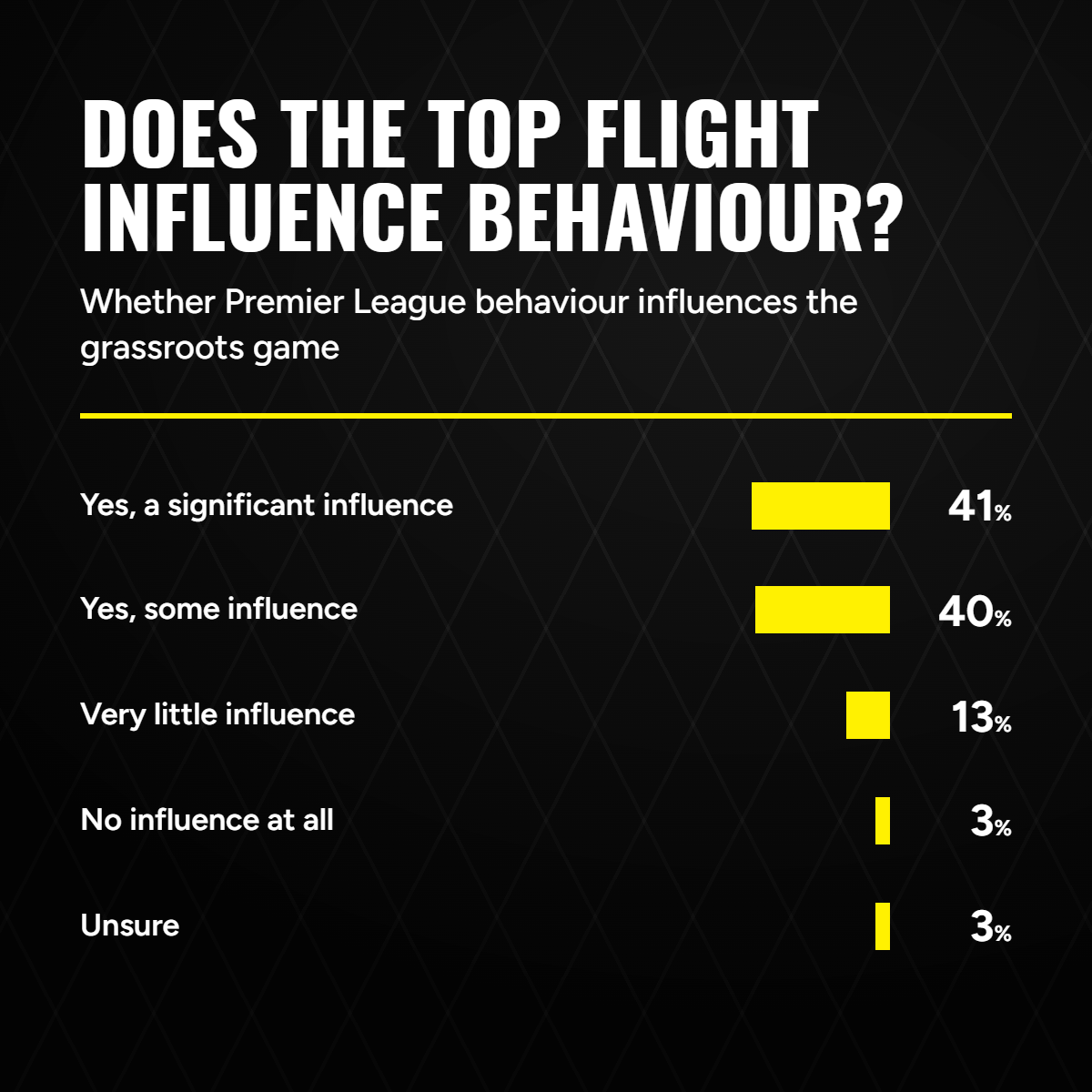
- 8 in 10 (81%) of clubs believe the behaviour of Premier League players and managers towards referees has an influence on the grassroots game
- Almost every club (99%) is reliant on volunteers to operate
The full findings are explored in detail throughout this report.
How Clubs Fund Themselves and Where the Money Goes
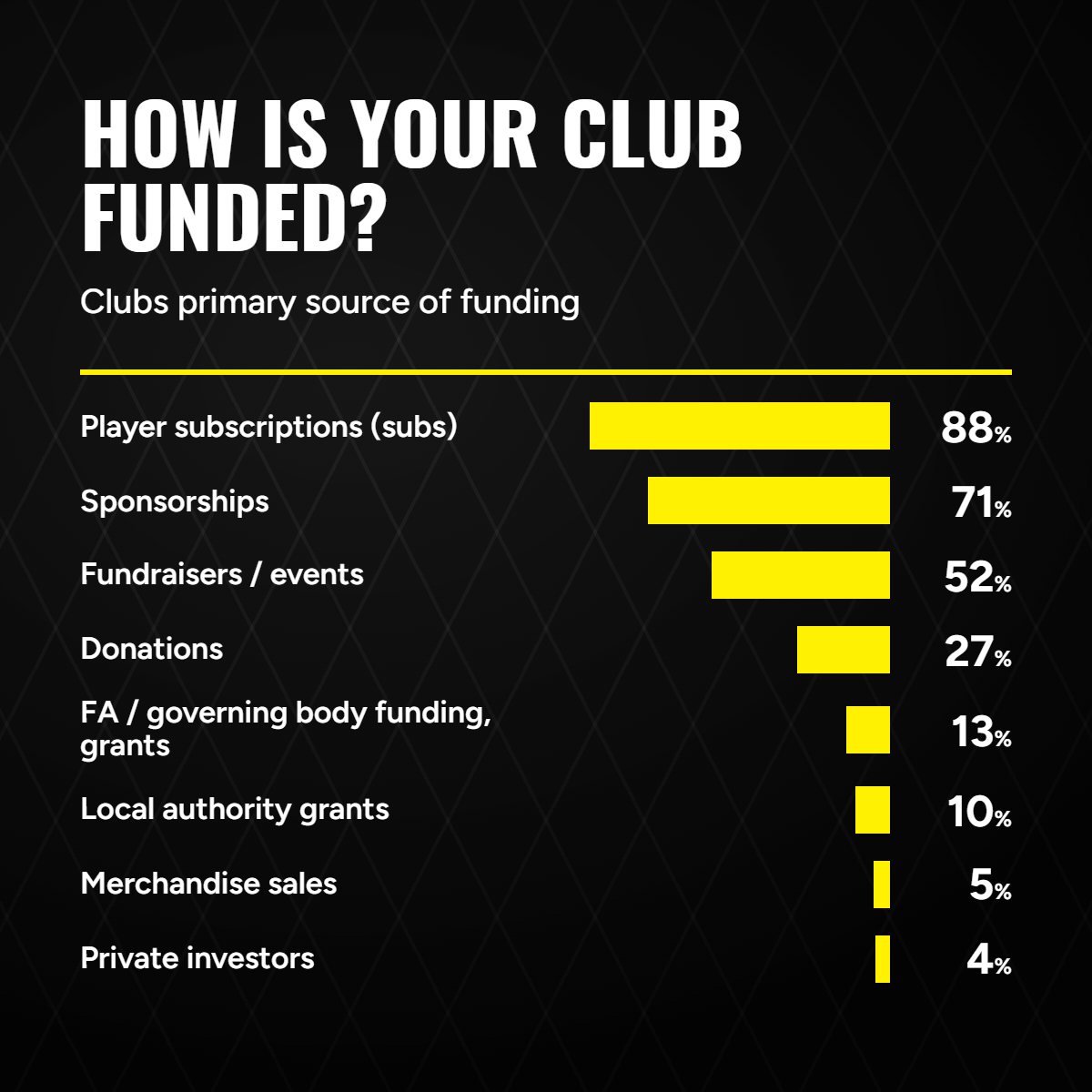
It’s clear that the majority of grassroots clubs rely on the same tried and tested fundraising tactics which include player subs (88%), sponsorships (71%) and fundraisers (52%), with grants and government utilised by less than 1 in 4 (23%) to fund their activities. Unlike in the professional leagues clubs can’t rely on private investors either, and only 1 in 25 (4%) are lucky enough to benefit from a private backer.
Sponsorship itself is rarely aimed at the big-ticket items for clubs, as this goes towards essentials including football kits (93%) and equipment (74%), with only 27% going towards club facilities. To secure these sponsorships clubs are reliant on local businesses (85%) and personal networks (67%), rather than through deliberate funding strategies like online campaigns (25%).
Grassroots Clubs are Feeling the Squeeze
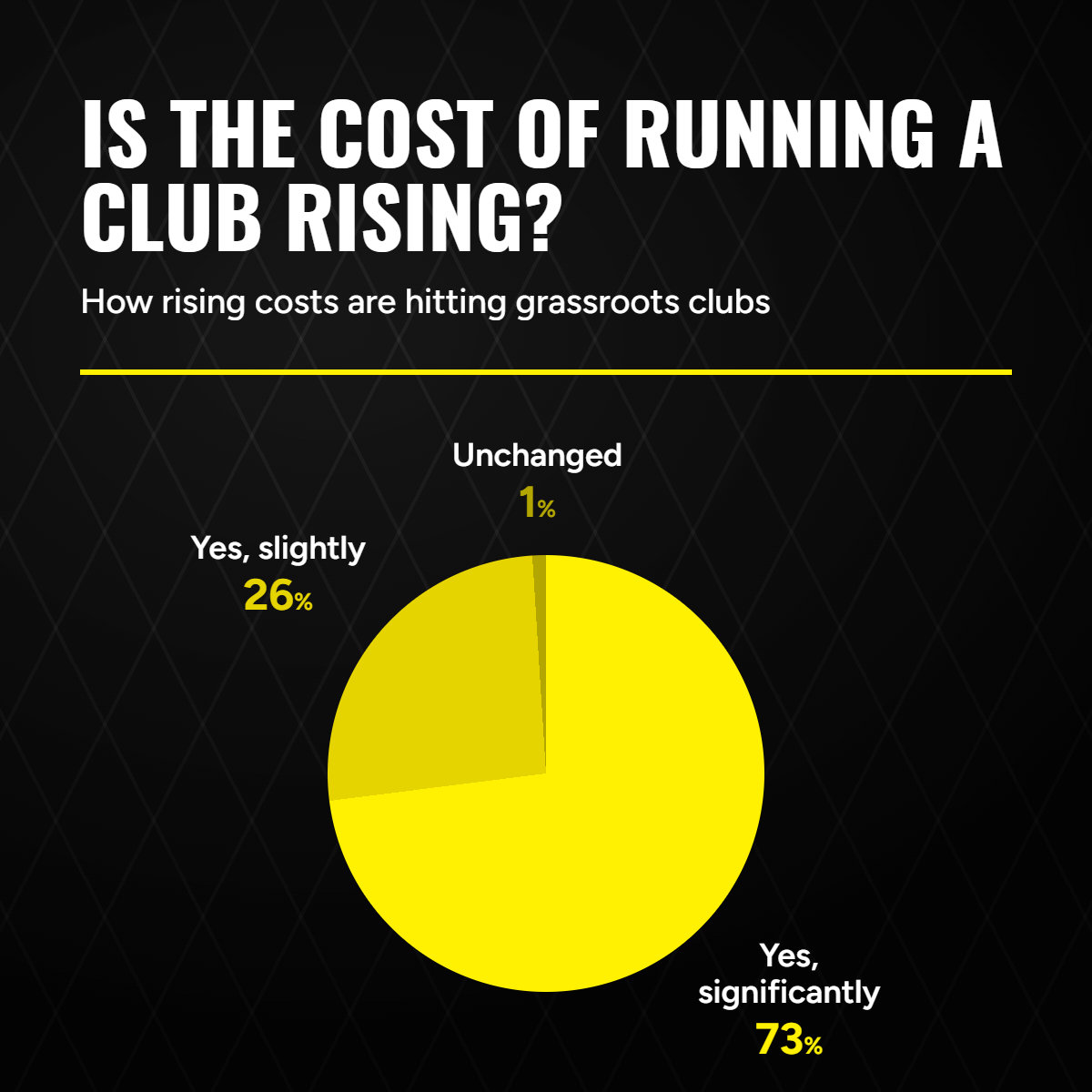
Despite all the funds that clubs raise, our survey shows that rising costs are at the top of the agenda for the majority, with many believing that it is becoming increasingly unsustainable for clubs to cover the costs. Almost every club surveyed (99%) has seen their costs rise in the past year, with nearly three quarters describing the increase as significant.
Nearly 3 in 5 clubs' (58%) weekly running costs are now £250 a week or more, and for nearly 1 in 5 clubs (18%) their weekly costs exceed £1,000. In comparison, only 13% of clubs had weekly outgoings of £1,000+ in 2025, which shows how quickly costs are rising.
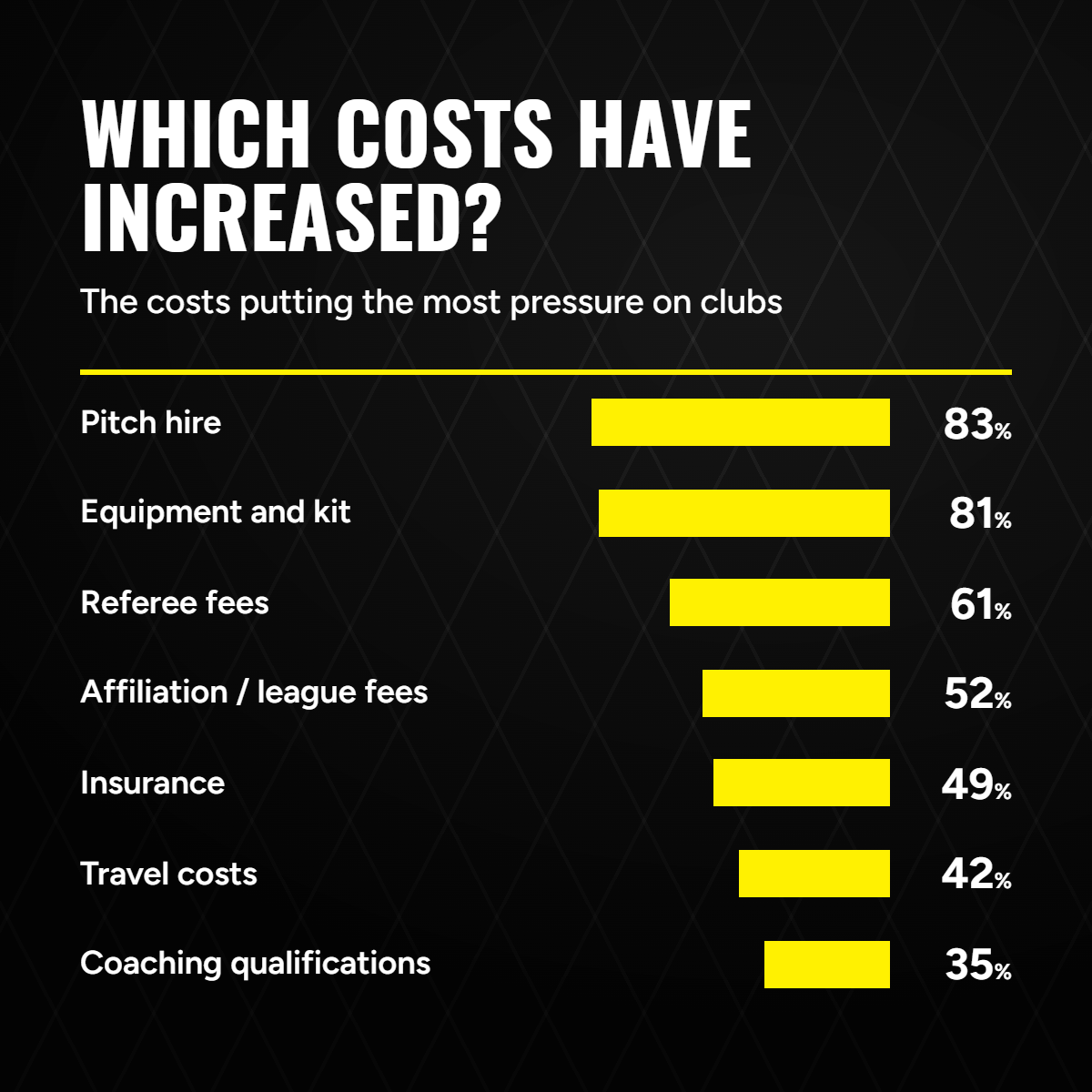
The main driver for this is pitch hire. Over eight in ten clubs (83%) have seen pitch hire costs increase, and half of all club representatives name it as the expense that increased the most in the past 12 months. This is compounded by the fact that only 15% of clubs own their facilities outright, meaning that the rest are beholden to local authorities, private landlords or lease agreements.
Equipment and kit costs follow closely behind, rising for 81% of clubs, while referee fees (61%), affiliation and league fees (52%) and insurance (49%), round out a picture of costs increasing on every front at once.
Clubs Dig Deep to Cover Rising Costs
To meet these rising costs clubs have to work even harder, prioritising certain revenue streams that they know will help generate additional funds beyond their already established sources of funding. Yet the resilience and initiative of grassroots clubs have been key to tackling this. Our survey shows which revenue streams clubs have turned to in order to meet the growing costs of running a grassroots club.
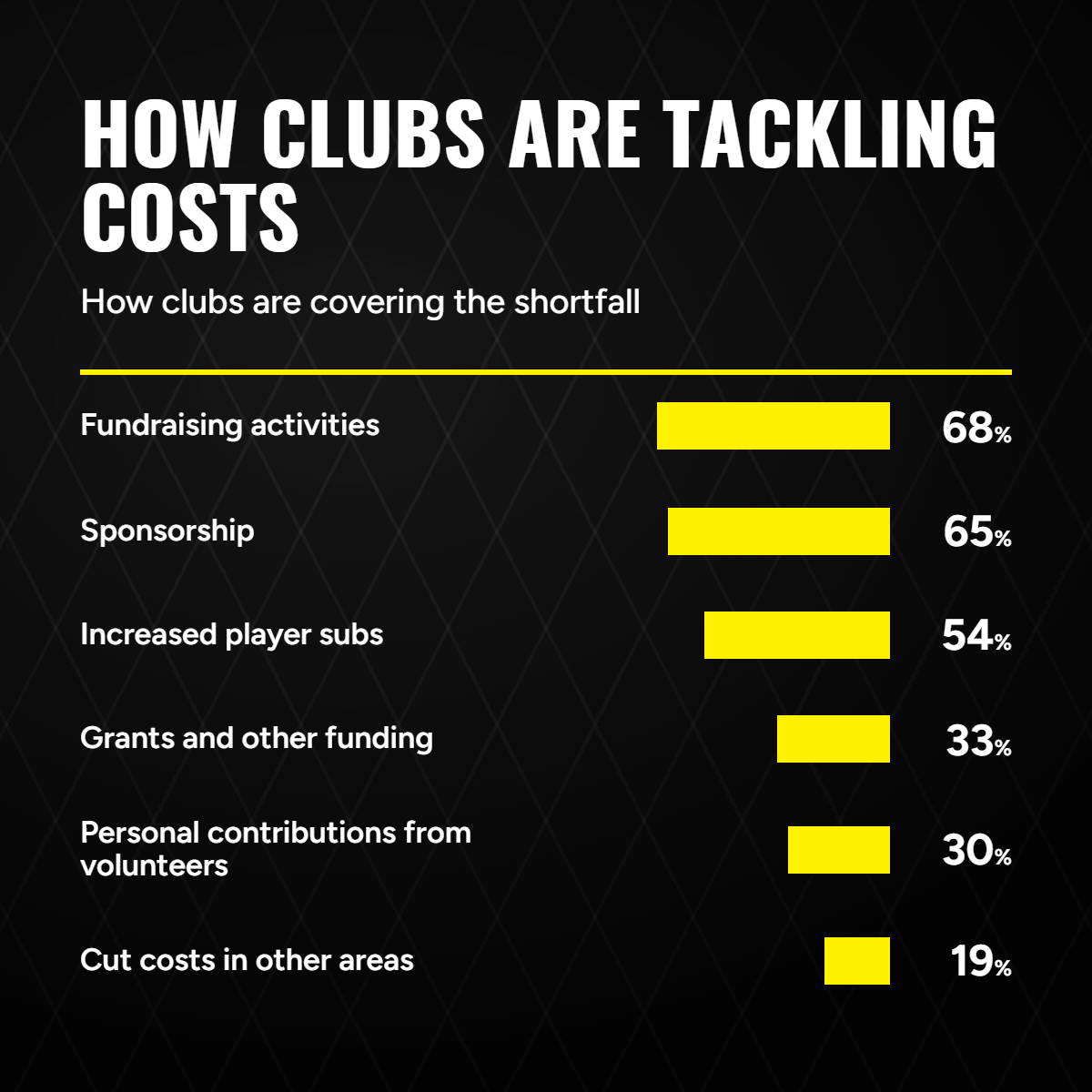
Over two-thirds (68%) are increasingly reliant on fundraising activities and 65% on sponsorship to plug the gap, while 54% have had no choice but to increase player subs, passing the cost directly on to families and players.
Perhaps most tellingly, three in ten clubs (30%) say they depend on personal financial contributions from volunteers and officials to keep the lights on.
The Equipment Crisis Clubs Can’t Fix
Behind every match played at grassroots level is a club scrambling to keep its equipment fit for purpose. Over half of clubs (54%) say they don’t have enough equipment to operate properly, and nearly half (46%) admit they are currently using kit that has deteriorated beyond normal wear and tear.

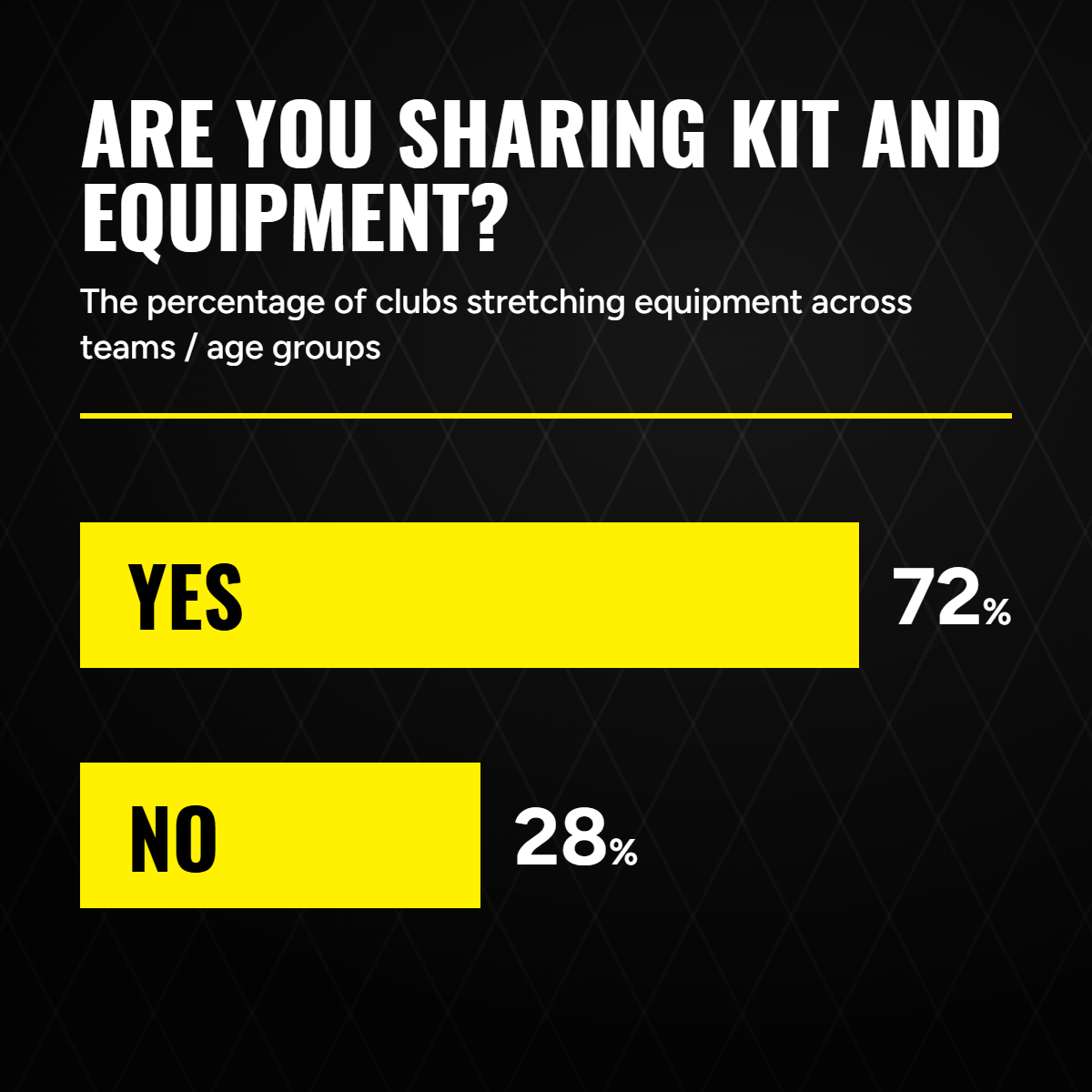
The strain is made worse by how thinly this equipment is stretched, with 72% of clubs sharing equipment across multiple teams and age groups, meaning a single set of goals, cones or first aid kits are often doing the work of several.
The overall condition tells a bit of a mixed story. Just under half of clubs (47%) rate their equipment as merely “adequate” and 14% rate it poor or very poor. On the other hand, nearly three times that number (38%) actually consider their equipment as good or excellent.
Women’s & Girls Football is Still on the Rise
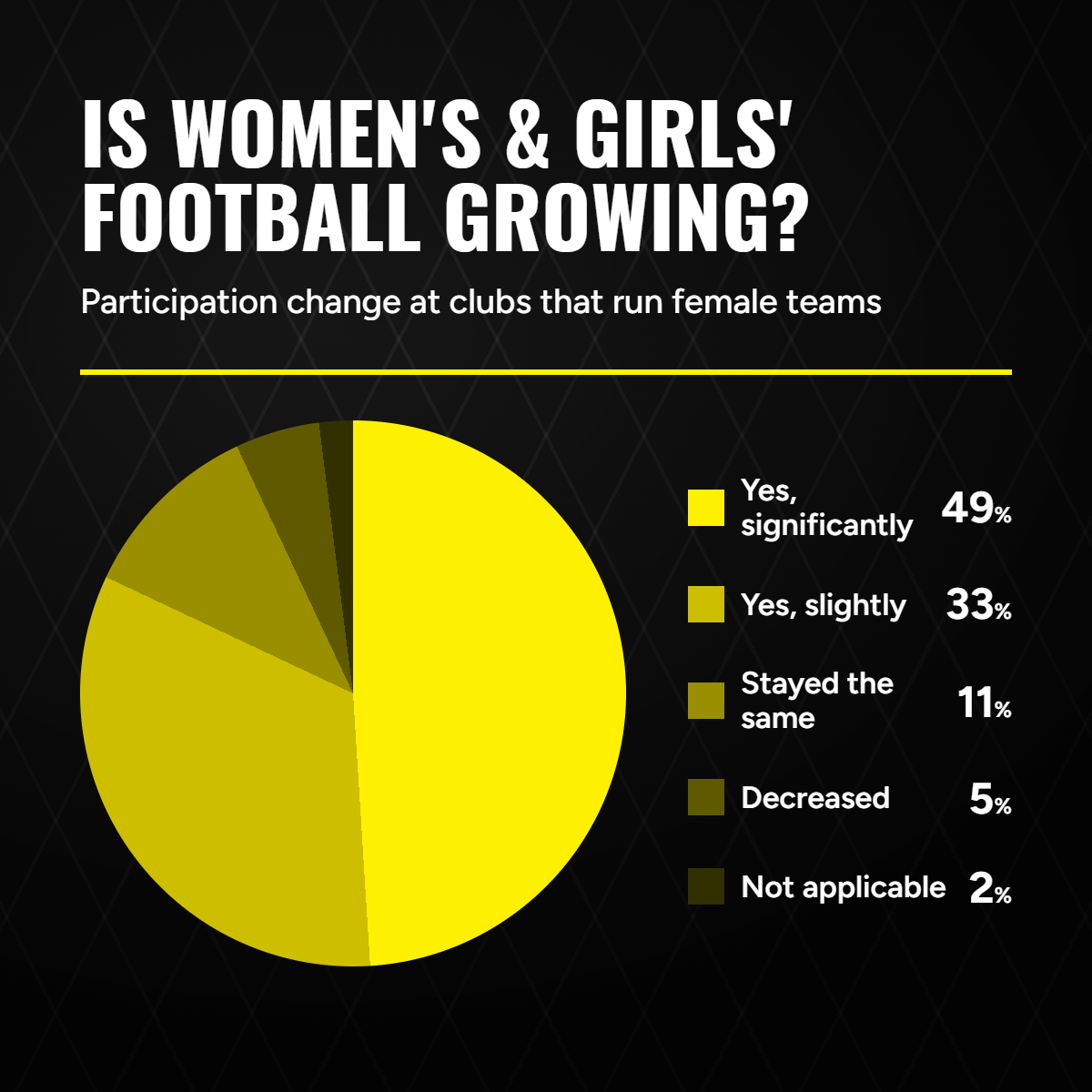
Shedding some light on the report, women’s and girls’ football is still on the rise at grassroots level. Our report shows that two thirds of clubs (68%) now have a women’s or girls team or are actively setting one up. Among those with an existing team, participation has grown, with 82% reporting growth in the past 12 months.
The growth has widely been credited to the professional game with 88% of clubs believing that the success of the Lionesses and the growth of the WSL has inspired more girls to play, with more than half saying the impact has been noticeable rather than marginal.
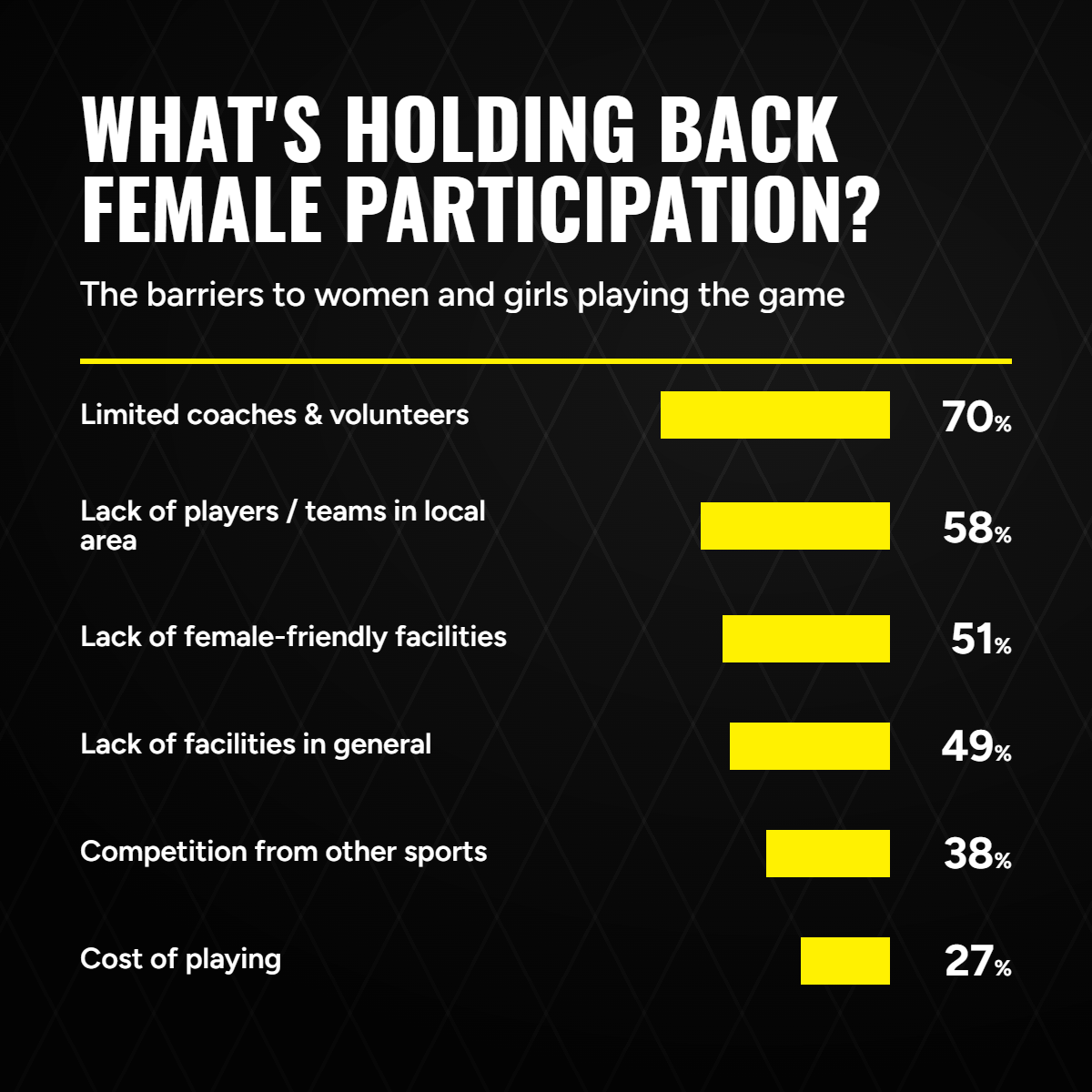
Clubs are clear that inspiration alone is not enough. When asked what’s holding participation back, the top answer isn’t a lack of interest, it’s a lack of infrastructure to meet it. Limited coaches and volunteers are the most cited barrier overall (70%), ahead of a lack of players or teams in the local area to compete against (58%) and a lack of female friendly facilities (51%).
The result is a mixed verdict on whether the grassroots game is rising to the moment. While 58% of clubs feel enough is being done to make football accessible to women and girls, a significant 34% disagree.
Abuse on the Sidelines is Driving Referees Away
As part of our new report, we wanted to investigate what is happening to referees at grassroots level. What we have found is that there is a respect problem, and clubs are in no doubt about where it stems from.
9 in 10 clubs (90%) say they have witnessed abuse directed at a match official in the past 12 months, and a further 62% believe the problem has worsened over time.
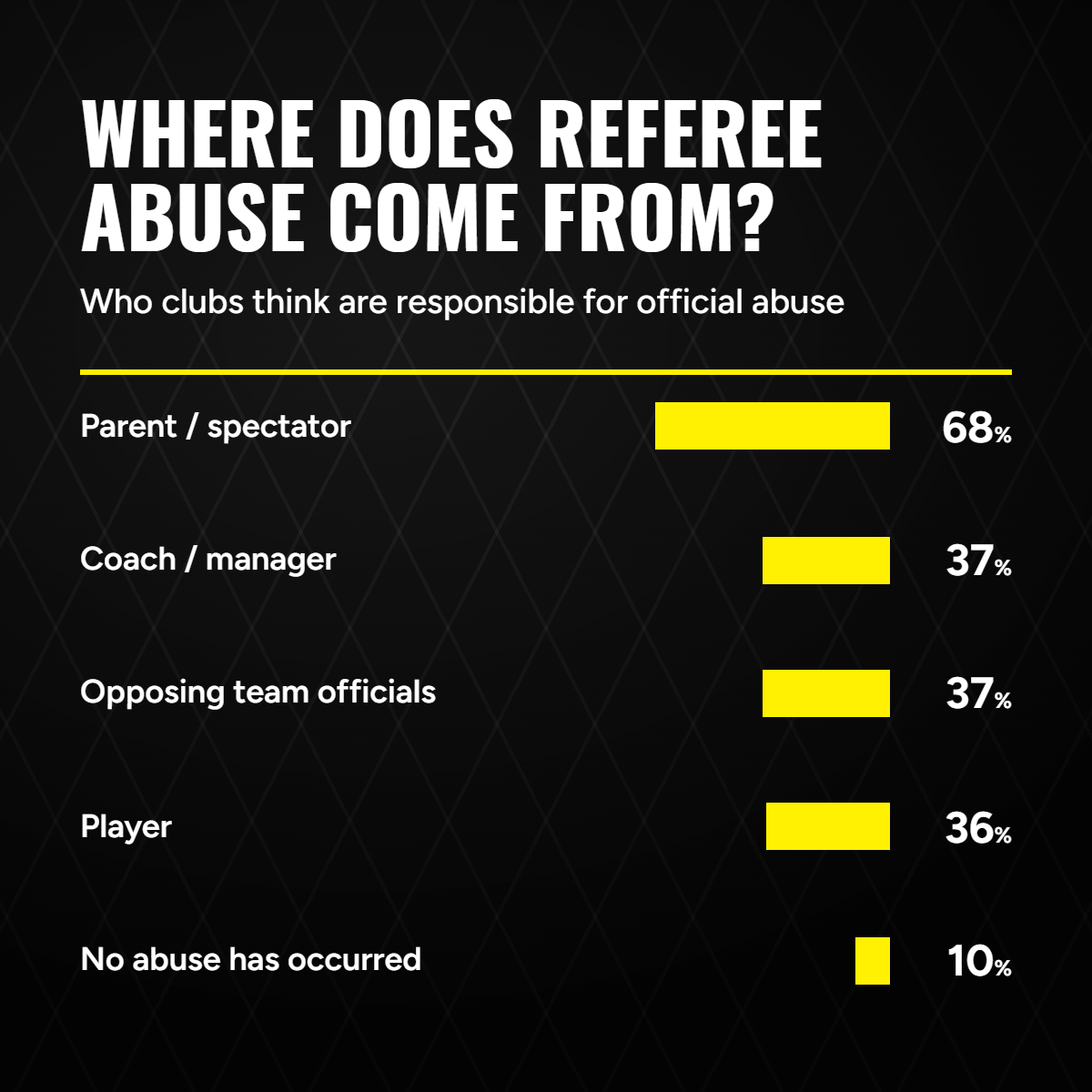
The data points squarely at the sidelines rather than the pitch, with more than two thirds (68%) of grassroots clubs stating that they think parents and spectators are responsible for abuse of officials. This is followed by 37% for coaches/managers and opposing team officials and 36% for players. Only 10% of clubs have said they have seen no abuse occur.
Clubs also draw a direct line from the professional game to their own touchline. Over 8 in 10 (81%) believe the behaviour of Premier League players and managers towards referees influences how the game is played and officiated at grassroots level. This is telling and suggests that the abuse at grassroots level is not separated from conversations about conduct at the top of the sport.
The cost of this is a shrinking number of people wanting to become match officials. 6 in 10 clubs (61%) say a referee shortage is a serious problem already affecting games and more than three quarters (77%) believe a fear of abuse is actively putting people off, a problem which if left unaddressed, could threaten the very game itself.
A shortage of officials is an issue that was flagged in our 2025 report, and the number of clubs that reported they'd had to cancel fixtures due to a lack of referees has grown from 16% last year to 21% in 2026.
Volunteers Holding Grassroots Football Together
One of the starkest sections in last year’s report looked at how almost all clubs were entirely reliant on volunteers. A year has passed and the statistics tell a similar story, almost every club (99%) describe themselves as reliant on volunteers to operate, yet 78% say it has become harder to recruit and retain them in recent years, with over a third (36%) saying significantly so.
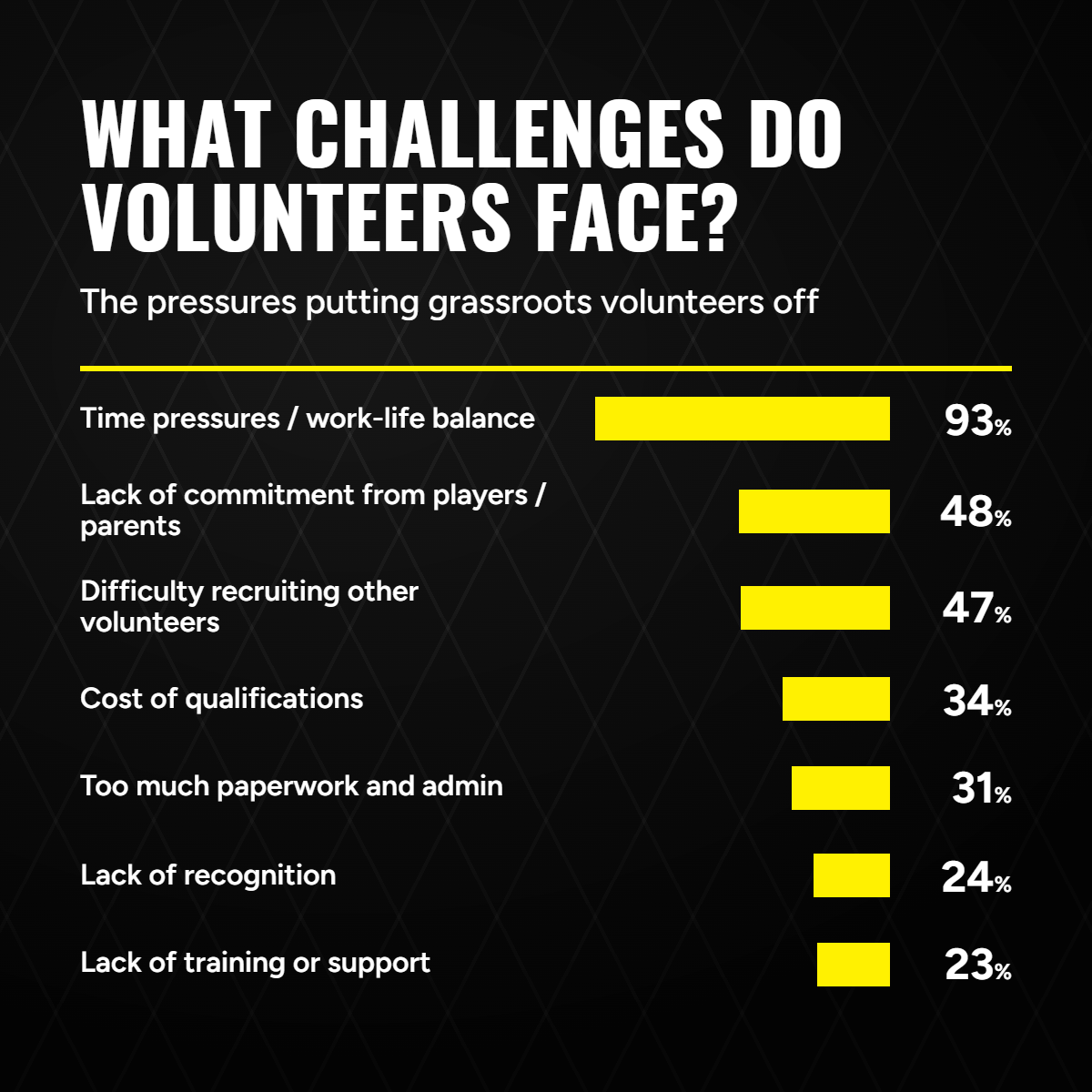
When asked what challenges their volunteers face, 93% of clubs point to time pressure and work-life balance, an issue which is dominant compared to others. Behind it, a lack of commitment from players and parents (48%), difficulty finding people willing to step up (47%), the cost of coaching qualifications (34%) and a growing burden on paperwork and admin (31%).
The scale of what is being asked of volunteers varies between clubs. Nearly half of clubs (45%) can call on a team of more than 20 people, but over a fifth (21%) are operating with just one to five holding the entire club together. For small clubs, just losing one volunteer can become an existential crisis. An aging volunteer base is something many clubs have highlighted as an issue and this was something our data confirmed, with the number of respondents to our survey aged 55+ increasing from 15% in 2025 to 20% in 2026. This year's report did highlight a growing number of under 20's getting involved, but not nearly enough to fill the gap.
Conclusion
Taken together, these findings paint a picture of a grassroots game that is being held together by extraordinary goodwill, but under strain on almost every front. Costs are rising faster than clubs can absorb them, government funding is failing to reach those in need, equipment is being stretched thin, and the volunteers who keep it all running are increasingly hard to find. When asked directly what the biggest challenge facing their club is, they point towards a lack of funding and sponsorship, closely followed by rising facility and equipment costs.
However, not all faith has been lost. The everlasting resilience of grassroots clubs to press on through pressure was shown when 78% of respondents stated they were optimistic about their club. Tellingly, that confidence dipped slightly when the question turned to the future of grassroots football as a whole, where only 64% feel the same optimism. Respondents trust their clubs and communities but remain sceptical about the wider system. Although optimism is an overall positive, this has dipped slightly in comparison to last year.
When asked what they enjoy most about grassroots football, the answer clubs given more than any other is watching players grow in confidence and skill (87%), followed by the passion and love for football (79%), building friendships and connections (76%) and the team spirit and shared achievement (also 76%). When asked to pick the biggest single factor they enjoy most about grassroots football 32% chose seeing players grow in confidence and skill, showing the selfless nature of grassroots volunteers up and down the country.

These are the same volunteers who report rising costs, a lack of funding, official abuse and a shortage if equipment, which shows that no matter what the challenges facing grassroots football are, for the love of the game, volunteers keep turning up.
That's the reason grassroots football keeps going, regardless of what it costs them.
Summary
FORZA continues to produce accessible and innovative professional sporting goods and equipment, intended to lower the bar of entry for aspirational players and clubs across the UK and beyond. As part of this research, respondents were entered into a £1000 prize pool, 6 clubs have been awarded vouchers with the main winner getting £500 and the other five receiving £100 to spend on FORZA equipment such as football goals, goal nets, training equipment, footballs and other essential supplies to help refresh their equipment. In 2026 and beyond we will continue to support the sport we love, and we look forward to seeing the continued growth of grassroots clubs and their communities.