
FIT FOR LIFE: THE TRUE COST OF CHILDREN’S SPORT IN THE UK
In England alone, 3.6 million children aged five to 16 meet the Chief Medical Officer’s guidelines for taking part in an average of 60 minutes or more of sport and physical activity every day.
Alongside free activities such as walking and cycling, millions of young people also take part in organised and team sports, including football and rugby. But membership fees, lessons, kit, equipment and travel can all make participation increasingly expensive for families.
More than one in three (34%) UK parents say the cost of their child’s sport has a significant impact on their household finances, affecting their ability to pay for necessities such as food and bills.
So, what is the true cost of children playing sport in the UK, and are financial pressures beginning to push young people out of the activities they love?
To find out, FORZA surveyed UK parents of children aged five to 17, exploring how much families spend on sport, where the biggest financial pressures lie and whether rising costs are already affecting children’s participation.
For many young people, organised sport involves much more than simply turning up on matchday. Training, coaching, regular practice and the right equipment all play a part in helping children develop their skills and enjoy taking part.
In football, that might mean using football training equipment during practice, having access to football goals for kids to build confidence and technique, or wearing football kits as part of a team.
Together, these elements can help make sport feel structured, enjoyable and rewarding, giving children more opportunities to practise, improve and feel part of the game.
KEY FINDINGS
● The cost of children’s sport is no longer just eating into families’ disposable income – for some, it is affecting the essentials. Two-thirds (66%) of parents say their child’s sport places a moderate or significant amount of financial pressure on their household, while 34% say the impact is significant enough to affect their ability to pay for necessities such as food and bills.
● Cost is already changing whether children can take part at all. One in three (32%) parents say their child has reduced their participation because of the cost, while 18% say their child has not started or enrolled in a sport, club, team or competition because it was too expensive. A further 7% say their child has stopped participating in a sport altogether because of the cost.
● This is not only an issue affecting the lowest- income households. Over three-quarters (77%) of households earning £50,000–£59,999 and 75% earning £40,000–£49,999 report moderate or significant financial pressure from children’s sport, suggesting the squeeze is reaching families well into the middle-income brackets.
● Parents fear the problem could get worse. 66% are concerned that costs could force their child to reduce or stop participating in sport within the next 12 months, meaning today’s financial pressure risks becoming a wider participation problem.
● The expense goes far beyond simply buying kit. Membership and participation fees are the most commonly cited financial challenge, selected by 31% of parents, while the median reported spend on a child’s sport is £60 per month, equivalent to around £720 a year.
THE MEDIAN REPORTED COST OF A CHILD’S SPORT IS £60 A MONTH
So, what does children’s sport actually cost families?
Across the UK, the median reported spend on a child’s sporting activities is £60 per month – equivalent to around £720 a year.
For many parents, however, the financial commitment is much greater. 27% report spending at least £100 per month, equivalent to £1,200 or more a year, while 14% spend at least £200 per month, equivalent to at least £2,400 a year.
Combined with recurring membership fees, lessons, travel and the cost of kit and equipment, those figures show how quickly keeping a child involved in sport can become a significant annual household expense.
HALF OF PARENTS SAY THE COST OF THEIR CHILD PLAYING SPORT HAS RISEN IN JUST 12 MONTHS
For many families, the price of keeping a child active is moving in the wrong direction.
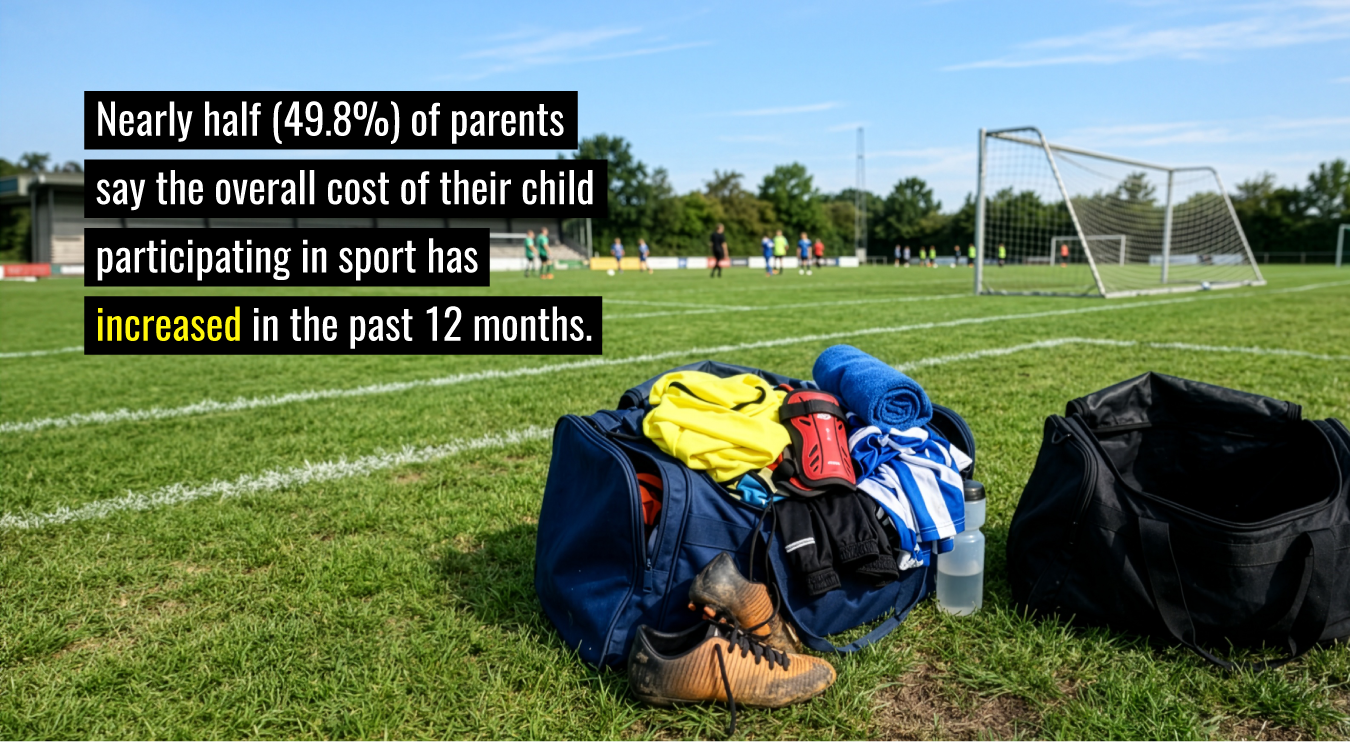
Nearly half (49.8%) of parents say the overall cost of their child participating in sport has increased in the past 12 months. By comparison, 43% say costs have stayed about the same, while just 3% have seen them decrease. The findings suggest that sport is becoming another growing household expense at a time when families are already having to make difficult decisions about where their money goes.
And the rise is being felt particularly strongly in some parts of the country.
| Children's Sport Participation Costs | |
|---|---|
| Change in Overall Cost | Percentage |
| Increased | 49.8% |
| Stayed about the same | 42.8% |
| Decreased | 2.7% |
| Don't know/unsure | 4.8% |
IN BRISTOL, ALMOST THREE-QUARTERS OF PARENTS SAY CHILDREN’S SPORT HAS BECOME MORE EXPENSIVE
Among the cities with at least 30 respondents, Bristol stands out. Almost three-quarters (74.5%) of parents surveyed whose nearest city is Bristol say the cost of their child participating in sport has increased over the past year.
Southampton follows at 58.5%, while more than half of parents in Nottingham (52.9%) and Birmingham (51.2%) also report an increase.
These findings are based on respondents' nearest city rather than their precise place of residence. Only cities with at least 30 respondents have been highlighted.
BRISTOL STANDS WELL ABOVE THE NATIONAL PICTURE
Bristol’s 74.5% result is notably higher than the national figure of 49.8%, suggesting parents around the city are feeling the rise in sports costs particularly strongly.
That comes against a wider backdrop of pressure on household budgets. Bristol has been identified as England’s least affordable city for renters, with average rent accounting for around 45% of local income – higher than Greater London at 42%.
ONS figures also show average private rent in Bristol reached £1,880 per month in July 2026, up 6.5% year-on-year. While housing costs do not explain the survey result on their own, they show the financial pressure some Bristol families are already facing before the costs of memberships, coaching, travel, kit and equipment are added.
SOUTHAMPTON FAMILIES ARE ALSO SEEING RISING COSTS ON MULTIPLE FRONTS
Southampton ranks second in the survey, with 58.5% of respondents saying the cost of their child participating in sport has increased over the past year.
Families in the city are also facing rising housing costs. ONS figures show average private rent in Southampton reached £1,255 per month in July 2026, up 3.1% from £1,217 a year earlier – slightly higher than the 2.9% increase recorded across the South East.
As with Bristol, this does not establish why sports costs have risen, but it shows that parents reporting higher participation costs are doing so against a wider backdrop of increasing household expenses.
LONDON’S MUCH LARGER SAMPLE SITS EXACTLY IN LINE WITH THE NATIONAL RESULT
London presents an interesting contrast. It has by far the largest city sample in the survey, yet 49.8% say the cost of their child’s sport has increased – exactly the same as the national figure.
That puts Bristol 24.7 percentage points above the national and London result, while Southampton is 8.7 percentage points higher.
DOES THE NORTH-SOUTH DIVIDE EXTEND TO THE COST OF CHILDREN’S SPORT?
The UK’s north-south financial divide is well documented, with household incomes and living costs often differing significantly between regions. But when it comes to rising children’s sports costs, the findings do not follow such a straightforward geographic pattern.
In the south, Bristol records the highest figure in the study, with 74.5% of parents saying costs have increased, followed by Southampton at 58.5%. Yet Cardiff records the lowest figure of all the cities analysed at 38.2%, while London sits exactly in line with the national result at 49.8%.
There is similar variation further north. Nottingham records 52.9%, compared with 48.6% in Glasgow, 47.1% in Liverpool, 42.9% in Leeds and 40.6% in Manchester. Birmingham sits separately in the Midlands at 51.2%.
The variation suggests that the pressures families face cannot be explained by the traditional north-south divide alone. Instead, differences between individual cities may reflect a more complex mix of local club and coaching fees, the types of sport children participate in, and wider household costs.
What's clear is that rising sports costs are not concentrated in one half of the country, creating distinct local stories behind what is ultimately a UK-wide affordability issue.
FIT FOR LIFE: FORZA WANTS TO HELP REMOVE THE COST BARRIER TO SPORT
In response to the findings, FORZA is launching its Fit For Life campaign calling for greater access to sport and exercise for children regardless of household income.
The campaign aims to shine a light on the financial pressures facing families and help prevent cost from becoming the reason a child cannot start, continue or fully participate in sport.
ROBBIE HAYTER , DIRECTOR AT FORZA, said:
“Sport should be something every child has the opportunity to enjoy, regardless of their family’s financial situation. But our research shows that, for many parents, the cost of keeping a child involved is becoming harder to manage – and in some cases is already affecting whether they can take part at all.
“That is why we are launching Fit For Life. We want to use this campaign to highlight the pressures families are facing and encourage action that helps make sport more accessible, whether that means reducing the cost of participation, improving access to affordable opportunities or providing greater support for families.
“No child should have to miss out on the physical, social and personal benefits of sport simply because the cost has become too high.”
MEMBERSHIP FEES ARE THE BIGGEST FINANCIAL CHALLENGE FACING PARENTS
For many families, the biggest financial barrier to children’s sport is not the occasional cost of new kit or equipment, but the recurring price of taking part.
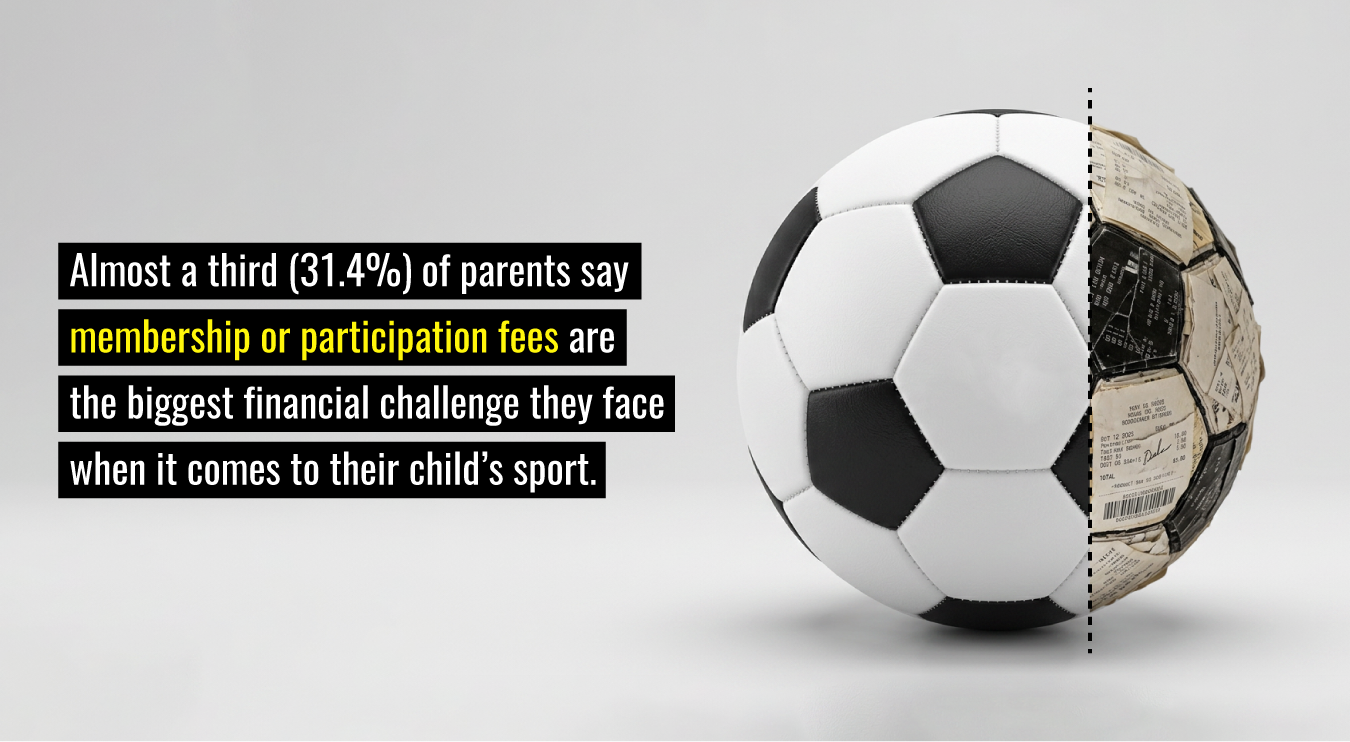
Almost a third (31.4%) of parents say membership or participation fees are the biggest financial challenge they face when it comes to their child’s sport.
Lessons follow at 20.6%, while 15.4% say sports equipment is their biggest challenge and 13.1% point to sports clothing.
Only 9.3% of parents say cost is not a financial challenge for their family, meaning more than nine in 10 identify at least one financial barrier associated with their child taking part in sport.
Crucially, the biggest pressure is not buying kit or equipment, but simply paying to participate. Membership and participation fees are cited by more than twice as many parents as sports equipment, suggesting that for many families, affordability is an ongoing problem rather than a one-off purchase.
That means that even where parents can find affordable football kits or football training equipment, recurring membership fees, lessons and other participation costs can continue to determine whether a child is able to stay involved.
WHERE FAMILIES ARE FEELING THE COST OF CHILDREN’S SPORT MOST
The type of financial pressure parents face can vary considerably depending on where they live.
In some cities, membership and participation fees dominate. In others, equipment, clothing or lessons take a much larger share of parents’ concerns.
SOUTHAMPTON: THE COST OF SIMPLY TAKING PART IS THE BIGGEST PRESSURE
Membership or participation fees are the standout concern in Southampton. 51.2% of respondents near the city name them as their biggest financial challenge, compared with 31.4% nationally.
Very few families feel untouched by cost. Just 2.4% say cost is not a financial challenge, the lowest proportion of any city included.
The picture suggests that, around Southampton, the biggest barrier is not necessarily buying kit once, but meeting the recurring cost of staying involved.
NOTTINGHAM: RECURRING FEES ARE ALSO A MUCH BIGGER ISSUE THAN AVERAGE
Participation costs are disproportionately high. 47.1% of Nottingham respondents point to membership or participation fees as their biggest challenge, 15.7 percentage points above the national figure.
Other costs fade into the background. Sports equipment is cited by just 4.6%, suggesting the main pressure here is access itself rather than what children need once they are taking part.
MANCHESTER AND LIVERPOOL BREAK THE NATIONAL PATTERN
Equipment matters much more in the North West. In Manchester, sports equipment and membership fees are tied as the biggest challenge at 26.4% each.
Liverpool goes one step further. Sports equipment is the leading concern at 23.5%, ahead of sports clothing at 20.6% and membership fees at 17.6%.
That makes both cities stand out from the national picture, where recurring participation fees are the clear number one issue.
FOR SOME FAMILIES, PAYING FOR SPORT NOW MEANS STRUGGLING WITH FOOD AND BILLS
The financial impact of children’s sport is not limited to having less disposable income.
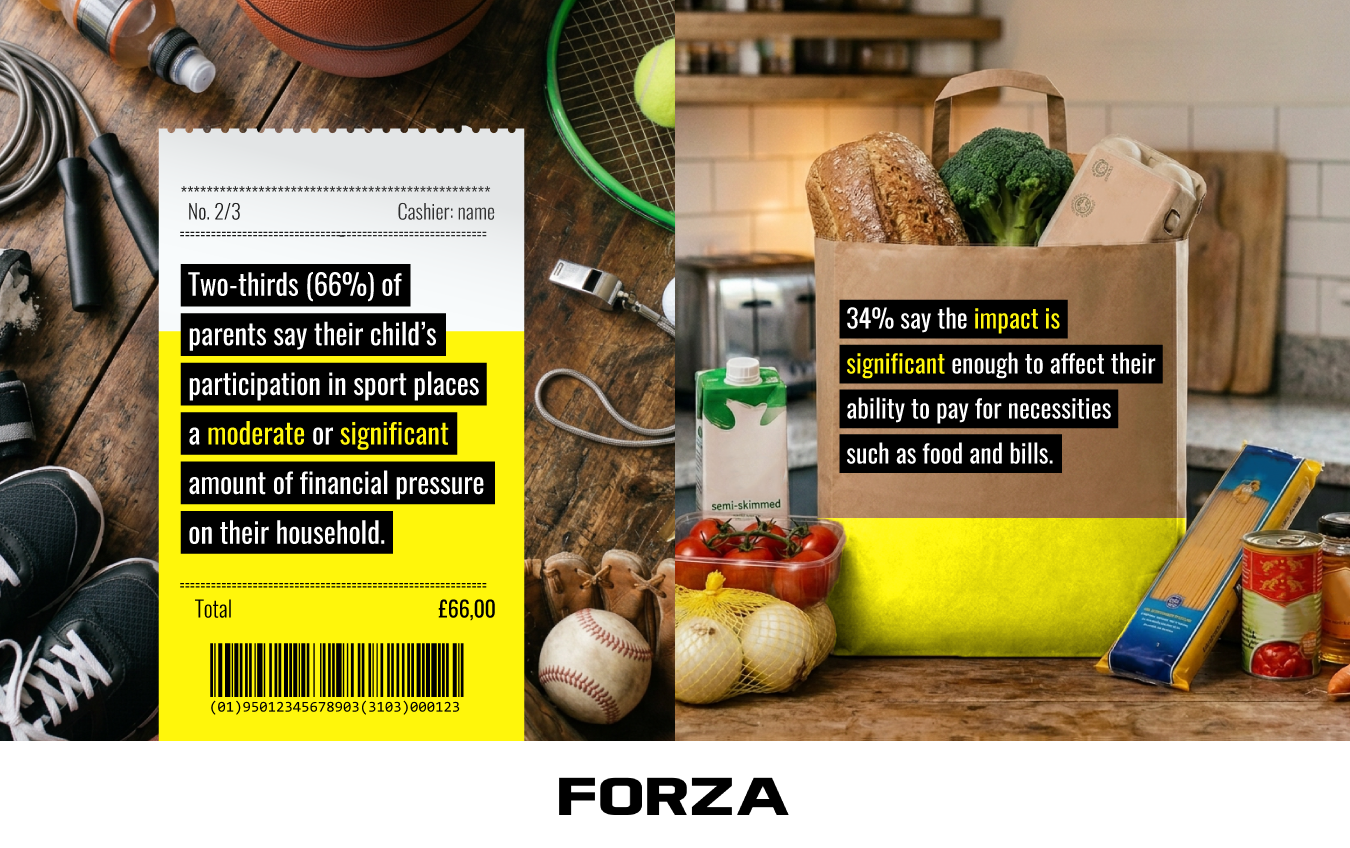
● Two-thirds (66%) of parents say their child’s participation in sport places a moderate or significant amount of financial pressure on their household.
● 34% say the impact is significant enough to affect their ability to pay for necessities such as food and bills.
● Just 12% say they can easily afford their child’s sporting activities without making any lifestyle changes.
That pressure is already forcing families to make difficult decisions. 12% say they have cut back on day-to-day household spending to maintain their child’s participation in sport, while the same proportion have reduced how much they save.
More importantly, the financial squeeze is beginning to change whether children can take part at all.
Almost one in three (32%) parents say their child has reduced their participation because of cost, while 18% say their child has not started or enrolled in a sport, club, team or competition because it was too expensive. A further 7% say their child has stopped participating in a sport altogether.
WHY BEING PRICED OUT OF SPORT MATTERS
The 18% who have not started a sport because of cost exposes a less visible side of the participation problem.
Children who leave a club or team can be counted as dropouts. Those whose families cannot afford to enrol them in the first place may never appear in participation figures at all.
NEIL HARRIS, CEO OF SPORT IN MIND, SAID:
“With one in five children aged 8–16 in England experiencing a probable mental health disorder, ensuring young people have access to activities that support their mental wellbeing has never been more important.
“Research shows that children who are more active tend to have higher levels of wellbeing, are happier and are less likely to experience loneliness, while there is also strong evidence that sport and physical activity can have a positive impact on diagnosed mental health conditions in children and young people.
“For many young people, sport is about so much more than being physically active. That’s why it is so concerning to see the financial barriers highlighted by FORZA’s research, with children already reducing or missing out on sport because their families cannot afford the cost. No child should be excluded from the mental and physical health benefits of sport because of their household income.
“Sport In Mind is proud to support FORZA’s campaign and its call for action to help make sport more affordable and accessible for every child.”
Parents also fear the situation could deteriorate further. 66% are concerned that costs could force their child to reduce or stop participating within the next 12 months, suggesting today’s affordability problem could lead to even more children missing out on sport in future.
THE FINANCIAL SQUEEZE EXTENDS WELL INTO MIDDLE-INCOME HOUSEHOLDS
The pressure is not confined to households on the lowest incomes.
77% of households earning £50,000–£59,999 report moderate or significant financial pressure from their child’s sport, while the figure stands at 75% among those earning £40,000–£49,999.
For families earning £40,000–£49,999, the impact is already affecting participation: 39% say their child has reduced their sporting participation because of cost, while 27% say their child has not started a sport because it was too expensive.
Even among households earning £70,000 plus, 47.6% report moderate or significant financial pressure, showing that the affordability of children’s sport is becoming an issue across a broad range of household incomes.
PARENTS WANT MORE FREE AND AFFORDABLE WAYS FOR CHILDREN TO TAKE PART
When asked what could make children’s sport more affordable, the most popular answer was more free or subsidised sports classes, selected by 23% of parents.
A further 19% want more affordable coaching, while 16% want greater government grants or financial support for families. Only 8% say they do not think the costs of children’s sport need to change.
The responses reinforce one of the clearest findings from the study: parents are not only asking for cheaper products, but for the recurring cost of accessing sport itself to come down.
METHODOLOGY
FORZA is a sports equipment brand supporting players, clubs, schools and families across grassroots and professional sport. As part of its Fit For Life campaign, FORZA commissioned this research to better understand the financial pressures affecting children’s participation in sport across the UK.
We surveyed 1,001 UK parents of children aged 5–17 whose children currently participate in sport, previously participated but stopped, or wanted to take part but were unable to do so via TLF Research between 20 and 25 August 2026.
Where respondents had more than one child, they were asked to answer about their oldest child. Results are based on unweighted survey responses.
Respondents were asked approximately how much they spend on that child’s sporting activities in a typical month. Because the answers were entered as exact amounts and included several extreme values, the median was used to represent typical monthly expenditure. This figure was multiplied by 12 to calculate its annual equivalent.
Geographic breakdowns are based on respondents’ nearest city rather than their precise place of residence. Only city-level findings where at least 30 people responded have been highlighted.
Percentages have been rounded to one decimal place, and figures from questions allowing multiple selections may not total 100%.